
The Yap Multiplier
When I speak to you one-on-one, assuming you’re listening, we’re in parity. I spend 5 minutes talking, you spend 5 minutes listening. If I divide your listening time by my speaking time, I get 1.
Let’s call this figure the Yap multiplier1.
I can up this number pretty easily by speaking in a larger group. If I speak to a group of 5 people for 5 minutes, then 25 mins listening divided by 5 mins speaking = a Yap Multiplier of 5.
Note that you can also just skip the post and play with the spreadsheet.
You gotta pump those numbers up
These are rookie numbers.
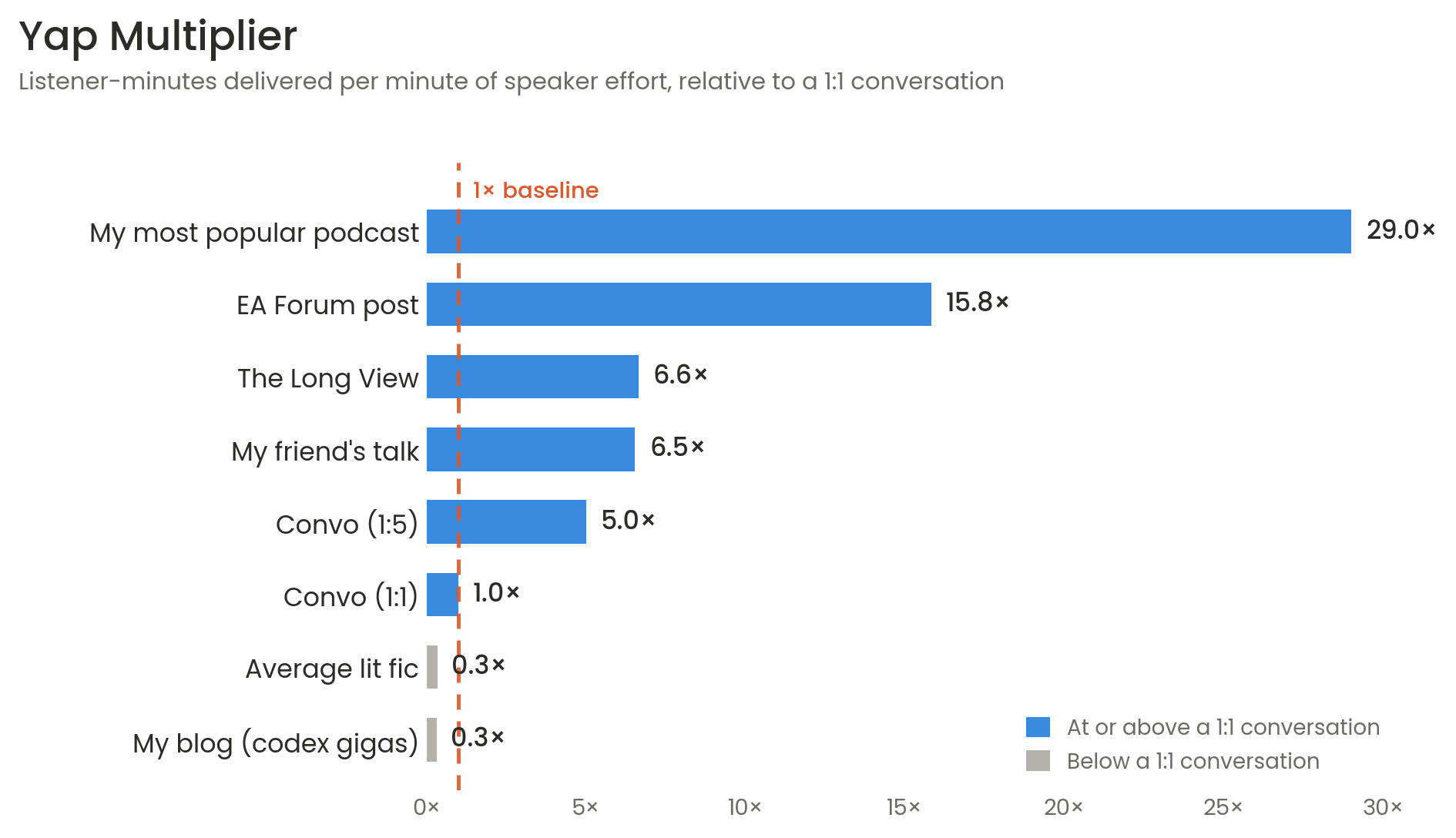
The other week, I was MCing a friend’s talk. There were around 100 people in the room. She spoke for 25 minutes, and I’d guess she spent around 5 hours preparing for the talk. Assuming that 15% of the audience wasn’t listening (it was the third day of a conference), we get a Yap Multiplier of 6.5. Not bad, but we can beat it.
Not with this blog, to be fair. My last post, Codex Gigas, looks like it had a Yap Multiplier of around 0.3, i.e. I spent longer writing it than people have spent reading it. That’s partially because on this blog, I’m not writing to a specific audience.
When I write on the EA Forum, I’m writing for an already assembled audience — the people who want to read about EA topics. My last substantive post on the Forum (If EA ruled the world, career advisors would tell some people to work for the postal service) has our highest score yet — 15.8.
Blogs, however, are probably chump change compared to podcasts. Podcasts often require prep, but speaking is far easier and less time consuming than writing.

That is, assuming I’m speaking to an audience of honeypuppys rather than Scott Alexanders.
My most popular podcast is currently sitting at a 29 Yap Multiplier, and I made that before AI tools made podcast editing much easier. Nowadays, I’d be hitting a score of 101. In contrast, the podcast that me and Frances put out on Friday is probably less than 1x — so far.
What about books? I only thought of writing this post because of books. I heard once that most authors never recoup the time spent writing in terms of the aggregated time spent reading. That thought seemed shocking at the time, but on calculating it, it seems true.
Let’s take literary fiction, a category which sells a lot of books overall, but where the average book sells a very small number (internet estimates are rubbish, but the figure of 250 which often comes up seems reasonable). Assuming that 40% of their purchasers read the book, and a book takes 10 full-time months to write, we get a Yap Multiplier of 0.3 for the average author.
These numbers, it could be said, have the faint smell of ass on them2. I can do slightly better if I focus on a book I have some insight on — The Long View. I was the research assistant on the book, so I can estimate roughly the amount of hours spent on it. I also have some vague ideas about sales i.e. that the book was neither a disappointment nor a rare breakout hit. Based on a conservative estimate of sales - 5000 (benchmarked on a reasonable number for that class of books rather than inside info), and an assumption that 40% of purchasers read the book, we get a score of 6.6.
These are the numbers achievable by mere mortals. What about the elite yappers?
Possibly the most elite yapper3 of them all is, regrettably, Joe Rogan. The Joe Rogan Experience sets a very high bar for Yap Multipliers. The average episode probably gets around 3.1 Million hours of listening. Let’s say he puts 50 hours into recording (5hrs x 10 people) and another 300 hrs into prep — the multiplier ends up as 8858x.
I’m not even going to compute short form video, but I expect that would lead to an even more extreme number.
Does any of this matter?
Well… there are too many variables missing for this to be a good proxy of your influence per hour of effort.
A street preacher could reach a 100x multiplier, but be taken seriously by none of his listeners. A memo on the desk of the president might be at a 0.01x multiplier, and still have been worth it.
The Long View reaching a (conservative) 6.6x is much more impressive than my podcast’s apparently higher score because it is asking much more of its reader, and represents a far more significant portion of work. In other words, each genuine reader is being more significantly communicated with than each genuine listener of a podcast.
However, I still think the Yap Multiplier is kind of fun. When you’re speaking in public in real life, you can physically see how many listeners you have. On the internet, it’s often pretty unclear. These numbers helped me realise how effort and reach are not particularly correlated in my work.
If you want to check out your own Yap Multiplier, or improve on my shoddy maths - make a copy of this spreadsheet.
I’ve also considered ‘The Narcissist’s Coefficient’ or the more neutral ‘Amplification Score’.
You may suspect that’s where I pulled them from.
Depending on your definition of ‘Elite’. More theistically inclined folks might believe that the most elite anything is God.
God, however, is the recipient of the lowest possible Yap Multiplier. In beginning was the word, and the word was God. The Bible is not theologically understood to have been written at a particular time — God is timeless and eternal, so the ideas in the book weren’t made within time. Therefore, we can call the preparation time infinite. Despite the Bible’s great sales record, that means an infinitely low Yap Multiplier.